


Inkling 2 Mini: Thinking Machines sends its layers round in circles
Thinking Machines has released Inkling 2 Mini, an open-weights model of about 20 GB that runs its middle layers three times for every token. It claims the top spot in agentic coding among open models under 100 billion parameters, and it fits on a laptop.
The announcement, spotted on Hacker News on 20 November 2026, comes from Thinking Machines: Inkling 2 Mini is an open-weights model, available the same day on Tinker, the company’s platform, for inference and customisation. The pitch fits in three adjectives: fast, powerful, and small enough for your laptop.
A transformer that goes back for thirds
The twist is in the architecture. Inkling 2 Mini is a “looped” transformer: its middle layers run three times for every token. The idea is to think more without writing more, and so to reach the right answer with fewer tokens, particularly in agentic coding.
On the spec sheet, it is a Mixture-of-Experts with 26.4 billion parameters in total, 3.4 billion of them active, which works out to 5.4 billion weight activations per token once the loop is counted.
A model that thinks without writing it down raises a monitoring question, since reading the chain of thought is how these systems get supervised. Thinking Machines says it measured this with a research variant that takes a variable number of loops, released at the same time. With no written reasoning, that variant’s time horizon goes from 16 seconds with one pass to 37 seconds with three. Its serial reasoning results keep improving up to ten loops, twice as many as it saw in training. The chain of thought gets shorter but stays readable, and agentic sabotage test results do not rise with the number of loops. These are the company’s own measurements, on its own model.
Twenty gigabytes and a MacBook on a plane
The total memory footprint is about 20 GB. Most of the weights were trained and are deployed natively in NVFP4, with the last four layers in MXFP8. That puts consumer laptops and dedicated AI desktops within reach.
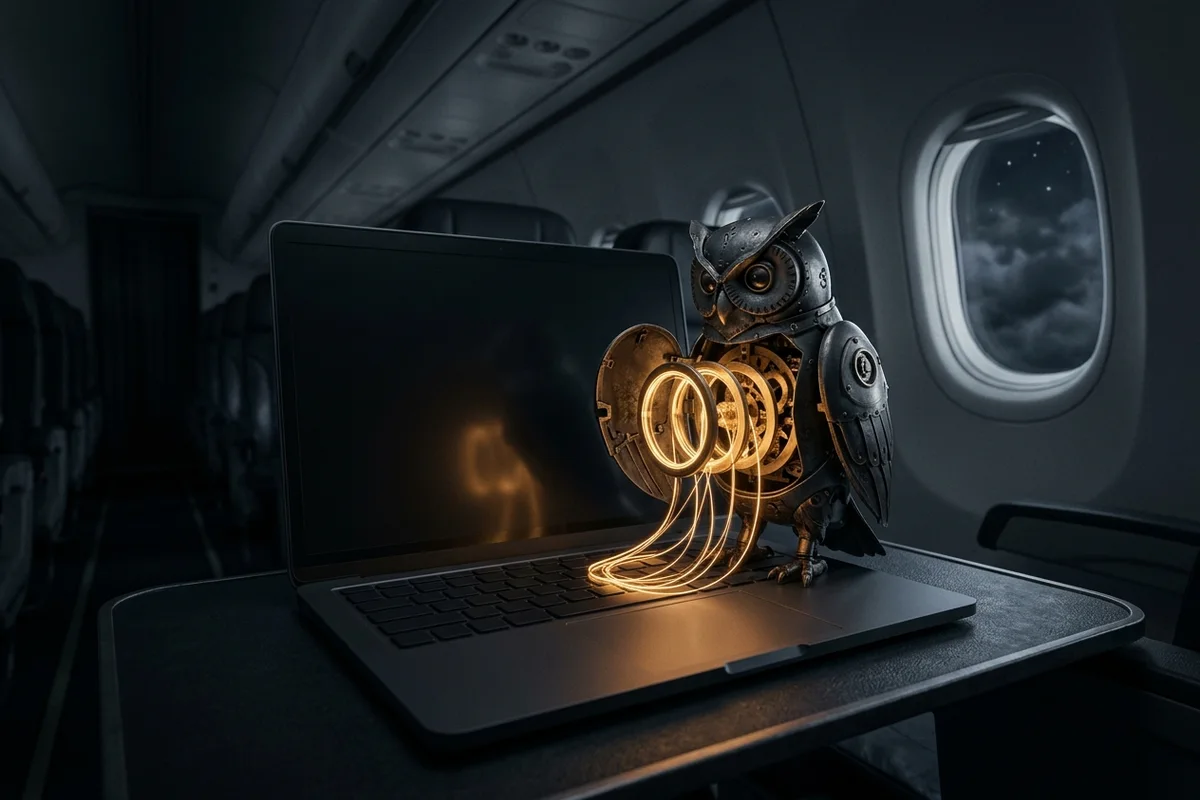
To make the point, the announcement says researchers took the model on a flight: offline, on a MacBook Pro, it built a playable flight simulator in a few minutes. Building a flight simulator from an airline seat is one way to tell the pilot you have notes.
Up against Qwen, Gemma and the rest
The comparison table lines up Gemma 4 31B, Muse Glimmer, Qwen3.8-27B and Nemotron 3.5 Super VL. On DeepSWE v1.1, Inkling 2 Mini posts 48.2%, ahead of Qwen3.8-27B (42.2%) and Nemotron 3.5 Super VL (24.7%), and far ahead of Muse Glimmer (4.4%) and Gemma 4 31B (0.3%). On SWE-bench Pro v2, it scores 77.9% against 73.8% for Qwen. On the Vals Index v2.2, it reaches 46.5%.
So the real rival is Qwen3.8-27B, and the contest is closer than the press release lets on:
- a tie at 20.1 on the AA Index v5.0;
- a tie at 5.6% on Terminal Bench v4.0;
- 15.1% against 14.9% on FrontierCode v2.0;
- Qwen ahead on Terminal Bench v2.1, 73.0% against 71.6%.
All of these figures are the ones published by Thinking Machines.
What the loop doesn’t buy you
The announcement is honest enough to say so: looping improves reasoning, not memory. Knowledge depends mostly on the total parameter count, and the model’s score on AA-Omniscience, a measure of factuality, stays average for its size. The workaround is search and tools: Inkling 2 Mini leads comparable open models on BrowseComp, DeepSearchQA and MCP Atlas.
As for price, the part of the announcement we were able to read gives none for use on Tinker. The weights are open, and the only cost with a number attached is memory: about 20 GB.
A model that goes over its answer three times before giving it: you probably know a few reply-all enthusiasts who could use the architecture.
Sources (1)
- Inkling 2 Minithinkingmachines.ai
Written with AI assistance from the sources cited above, then reviewed and approved before publication by Sébastien Soulier.